

Loading

Subscribe to this blog by Email

Your email:

Browse by Tag

Posts by Month

call 1.800.820.5656

ACT Contractors Forms... From The Paper Side of Contracting.

Current Articles | RSS Feed RSS Feed

Home Improvement Contractors Warranty Forms

     Most contractors miss the “boat” when they misuse or do not use a written warranty certificate in their business. The commonHow to use a construction warranty in your contracting business. idea is that by ignoring a formal warranty and by not bringing it up with the customer, warranties will never become an issue. Wrong!


     Contractors should know that in many cases, a contractor will be held to an implied warranty even if they do not formalize the terms in a written warranty form or certificate. We also know that most consumers expect some type of warranty with everything they purchase… including a home improvement. So what is the best way for a home improvement contractor to approach the nasty business of “standing behind” their work?

     First of all, you should ALWAYS use a formal written workmanship warranty! It is important that this warranty tell the customer the contractor is only responsible for their work and never for the materials or equipment installed by them. Clearly state that a defect in the materials and equipment is the responsibility of the manufacturer and that claims should be made directly to them.  This will eliminate many complaints, limit your exposure, and everyone understands that you are the “little guy” and can’t be responsible for the failure of the product you install… your responsibility is that you install their product correctly!

     Your warranty should be specific to the particulars of your trade. For example a roofing contractor’s warranty needs to take into account things like physical damage to the roof and leaks caused by the work of others.  A painting contractor’s warranty needs to cover under what circumstances they will be responsible for paint peeling and structural cracking. A general contractor’s warranty needs to cover lack of owner maintenance and normal “wear and tear”.  Every trade is different and the warranty form used must reflect that.

     The use of a written warranty as a selling tool is often overlooked by contractors. Give a copy of your written warranty certificate WITH THE BID… not with the contract or after the job is done. Look at your warranty as a means to help you get more work and not just a way to limit your exposure after the job is completed. Make your warranty something special to show the customer that, if they have you do the work, they can be confident you will stand behind everything you do. Never hide your warranty in the contract “boilerplate” like most contractors… as though your warranty is some dirty little secret you are trying to gloss over.

     Be proud of your warranty and make sure the customer KNOWS you are proud of it! It will help the “bid” you give become a paying customer!   

CA 20 Day Notice: Don't just send it, Explain it to the Recipient!

     Ok.  So you send a California 20 day notice to the property owner and to the prime contractor on the project... you know... just like you’re supposed to. Then it hits the fan.  You get a call from an indignant general contractor who asks you why you do not trust his company. "I pay ALL my subs"... he says so... "Why did you send the owner a Pre-Lien?"  Now here comes the kicker... "The owner is freaking out and you just made it hard for me to get a check cut and that makes it harder for me to cut a check to you!"angry over California 20 Day Notice

     Now you ask yourself if you should have sent the Preliminary Notice in the first place. You want to keep doing work for this general so the last thing you need is to make the guy mad… right? He’ll never call me for work again you think. Most of the time the general general contractor angry over preliminary noticepays so why was it worth all this hassle, for probably no reason, which might have cost me jobs from this guy.



     Let’s clear one thing up right now. Whenever the “people” who have control of the purse strings on ANY job with ANY general have not directly signed a contract with you… SEND THEM THE 20 DAY NOTICE! It protects you (every interested party knows you must be paid), it protects the general (the owner knows he needs to pay the general promptly so he can pay you and keep you happy) and it protects the owner (they know they need to make sure the general is paying you.. his sub)! The bad feelings you have created with the owner and the general are not because you have given them the 20 Day Notice.  These bad vibes happened because of the WAY you gave them the Pre-Lim Notice.

HUH???”… You think.  

     The real cause of this headache is because most people, general contractors included, look at the California Preliminary 20 Day Notice and see “LIEN!” It doesn’t matter that our California Preliminary Notice Form says right at the top “THIS IS NOT A LIEN”, the fact that they had to sign for it and that it has that “legal” look to it screams LAWYER!  And don’t you just love to get legal papers like this yourself? … It makes your day doesn’t it? No wonder someone freaks when they get one of these.

So… what did you do wrong and how can you keep this from happening in the future???

     “YOU DIDN’T EDUCATE THEM!”  You asked them to “eat” a “dry” legal form without any “sauce” to make it go down easier. ALWAYS include an explanatory letter (the sauce) when you give a Pre-Lien. If you purchase a 20 Day Notice from us or if you purchase ACT Contractors Forms on Disk for California Contractors (or for any other state that uses a notice like this) we always include a transmittal letter just for this purpose. Our letter, and so should yours, tells the person receiving the pre-lien, among other things, that:

1)  It is not a lien but rather a notice required by law for THEIR protection.

2)  It is to inform the recipient that you are a subcontractor on their project and have a right to lien if you are not paid.

3)  It does NOT mean the general is untrustworthy.

4)  It does not mean that the general has not been paying you or that the general owes you money.

5)  You have confidence in the general.

6)  By law, the recipient of this notice has a duty to see that you are paid from payments made to the general for work you have done.Transmittal Letter with pre-lien makes a smoother job

Use this transmittal letter as an opportunity to butter up the sub… not tear them down… that way they will still like you… and call you on their next job!

Contractor Forms: Mechanics Lien Strategy for Dummies

Collecting money owed a contractorMost contractors view filing a mechanic's lien as the last resort.... you know... "GOING LEGAL!" But you know what?  The mechanic’s lien process doesn't have to be the last resort and it most definitely does not have to mean "going legal." Let’s talk mechanic’s lien strategy.

In all my years as a contractor with thousands of home improvement customers there has never been one single time that I filed a CA mechanic’s lien form (believe me I’ve filed plenty) and felt completely satisfied with the outcome. There was always something that cropped up to "rain on my parade."

Sometimes the court would reduce the lien amount in an effort to make both parties "equally unhappy" rather than one party a winner and the other a loser... you know the "share the pain" philosophy. That's a tough one to swallow… you have to settle for less than your righteous indignation tells you is your due.

Sometimes the property already had so many claims that by the time everyone was paid out of a foreclosure sale my claim at the bottom of a very long list was worthless. The money would have run out long before it was my turn to be paid so I could not even get my legal fees back if I sued!
Once, long ago, when I first started out as a contractor, I filed the lien, got a judgment for the FULL amount (over 40K in 1981 dollars), went to foreclose on the new condo development, then found out that during the course of my time in the world of the courts, lawyers, and the law in general, the property had been sold and my judgment was set aside??? How could this be you ask?  I’ll answer that one in my later post in this series about the LIS PENDENS … say those words 10 times and NEVER FORGET THEM!     LIS PENDENS…. LIS PENDENS…

The whole point of all this is that the time to decide just how far you will push the collection process is BEFORE you decide to file that mechanic’s lien. 

Do Your Research! Here are some points to remember:

  1. Have a title search done on the property (that is what a title company does) to see just what is owed, and to whom, against the property. You will also get important information on the property like the legal description which you will need. This is money well spent and this information is public record.

  2. Find out what the property would reasonably sell for if foreclosure happens to make sure there is money there to pay you!

  3. Make sure this is not a “throw away” property that the owner does not have a problem with losing!

Armed with this information your next decision is just how far to go in the collection and mechanic’s lien process. Mechanic’s liens expire or as the attorneys say “become stale” after a certain time period… you can’t place a lien on the property forever and you can’t place the same lien again after it becomes stale!  In California, for example, a mechanic’s lien is “good” for 90 days. You have 90 days to file a lawsuit.  Once a lawsuit is filed the mechanic’s lien will remain in effect until the lawsuit is decided in court. This timeline varies from state to state but in California, you have 90 days after a mechanic’s lien is filed to decide if the circumstances are worth the expense of a lawsuit.  So, you ask, in many cases why bother with a mechanic’s lien?

Filing a mechanic’s lien in most states is easy to do and makes sense in many cases regardless of whether you plan on pursuing a lawsuit to foreclose or not.  Why... because mechanic’s liens RARELY go to a lawsuit unless other issues are involved such as a claim of poor workmanship. Would you want to lose a valuable property to foreclosure if there was another way?  Of course not and so it goes in most cases.  When the mechanic’s lien is filed, the property owner is usually eager to resolve the issue without adding legal fees to the money that is already owed.

NEGOTIATED SETTLEMENTS WORK! ... There are usually three reasons your customer is not paying.

  1. You are billing for things they did not agree upon in writing like verbal changes or extras. You blew it here by not getting extras and changes signed for so negotiate you’re a** off here since you will probably not prevail in court and something is better than nothing.

  2. They feel your work is bad and you either deny this without giving them an acceptable reason or they no longer have confidence in your taking care of the problem(s).  You blew it here by not taking care of “business” by allowing little problems to become one big problem so negotiate you’re a** off here also ... sometimes getting a friendly third party contractor here to take care of your real or customer perceived problems can be the answer. The judge is not an expert in construction but he is a consumer so arguments that things are really ok when the customer says they aren’t usually backfire.

  3. They do not have the money to pay you. This is the big one and all other reasons the customer gives you for not paying are many times just excuses for the fact that there is no more money.  You can offer a settlement for less, which I do not recommend, or…. Ask the customer to sign a trust deed for the amount they owe, add the maximum legal interest, and set up a payment schedule they can afford.  Sure, it may take years to get paid but a trust dead does not expire like a mechanics lien and it is secured by the property.  I did a job for a homeowner in 1982.  The fellow lost his job and did not have the money to pay me.  This was a $3,000 job that I took a trust dead on at the advice of my father who was a contractor for 50 years. Just a few payments were made but the trust dead remained in effect. A few years back this fellow died and a few years after that his wife died… guess what… the executor of his estate paid almost 25 years of interest on that $3,000 so the home could be sold by the fellow’s children who inherited it. I got a check for almost $35K. While this is out of the ordinary, the point is that taking a secured trust deed when the money “well” dries up is a great alternative to “going legal” and possibly spending money to get nothing.

The best reason to use a mechanics lien is to provide a reason for your customer to WANT TO NEGOTIATE with you to avoid the alternative… even if you don’t plan on going to court for foreclosure proceedings … in most cases, your customer doesn’t know that! 

Contractor Forms: CA 20 Day Notice Applies to Material Suppliers

Question: Does the California (CA) 20 Day Notice requirements apply to material suppliers as they do subcontractors?

Posted January 18 by P. Foreman... "We are a MATERIALS supplier, in the form of custom-built wood windows. We do not do any on-site work. Do the same 20-Day notice regs. apply to material suppliers as they do to subcontractors? Also, as building the windows can take many, many weeks with several deliveries to the job-site, can we file a pre-lein up until the LAST delivery, which may be long after 20 days of actually beginning the process of building all the windows?

 Contractor confused about California Contractor Forms

Yes, the 20-day notice does apply to California (CA) material suppliers in the same way as it does to subcontractors on the job. The purpose of the California Preliminary Notice, aka 20 Day Notice, aka Pre-lim or Pre-Lien, is to inform those parties who have the "purse strings" on the job that somebody is supplying labor and/or materials or equipment on their project and that these same "somebodies" have a right to be paid "out of the property" through the mechanic's lien process if they are not paid as the contract states. Let’s call these "purse string" holders the project "funders" (the property owner, property manager, bank, funding control company- you know, the project funders who cut the checks).

Why is this notice necessary...you ask?  Because subs and suppliers are usually "insulated" from the project "funders" by the General Contractor! The only way the project "funders" can truly know who is actually a subcontractor or material supplier on their project is if they are notified of this when they receive a 20 day notice! The project funders usually have no direct dealings with the subs and suppliers.  The project funders deal directly with the General Contractor who is, in turn, directly dealing with the subs and suppliers!  If you are "cutting" a check to the General Contractor on your job for a progress payment, and you know which subs and suppliers contributed to and should be paid from this progress payment... then you can require lien releases from the subs and suppliers showing they have been paid. The subs and suppliers interests are protected (they get paid what and when they should) and the owner and lenders interests are protected (they will not be surprised by a mechanic's lien from someone they didn't even know about).

You can file a 20-day notice anytime... but you will only have lien rights for work/deliveries of materials (in your case windows) done in the preceding 20 days from the date the Preliminary Notice is served. The value of all work/deliveries of materials made or done prior to 20 days before the Pre-Lien is served cannot be included in any lien that you might file.  So, for example, if you are working for a month (30 days) on a project and decide to file a 20 Day Preliminary Notice, you will only have lien rights for the work/materials supplied after day 10 which is 20 days prior to the date the 20 day notice is served on day 30. Serving the 20 Day Notice sooner rather than later is critical to protecting your rights!   You MUST make it your standard business procedure to serve the 20-day preliminary notice at the start of the job... preferably right after the contract/agreement/order is signed with your customer... make the 20 day notice part of your paperwork when you begin to first process the order/contract/agreement! Don't put this off ... that way ALL your work/expenses will be covered in any lien you might need to file! Slow pay and NO pay is the rule nowadays rather than the exception... make sure your customers understand that the 20 day notice is a part of doing business with you.

This system works if it is followed yet I am amazed at how often I am contacted by banks and property owners who seek 20 day notice forms and lien release forms for subs and suppliers on their project! The contracting "business" demands that EVERY contractor have their own legal forms, such as these, to be paid! This is the LAW rather than the exception so, Mr. Contractor or Mr. Supplier, if your check is "held up" because you do not have a lien release to give the project owner, as the LAW REQUIRES, it's not their fault now... is it?

Contractor Form: The California Preliminary Notice or 20 Day Notice

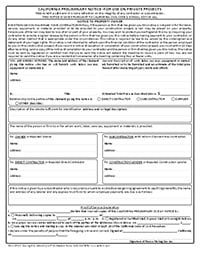
One of the most commonly requested forms for California is the California Preliminary Notice, sometimes called the CPN Form, California 20 Day Notice or California Pre-Lien or California Pre-Lim. Five different names for the same form. The CPN or California Preliminary Notice, is often the first step in the California Mechanics Lien process so it is no wonder these forms are popular!


What is the California Preliminary Notice?

The California preliminary notice or 20 Day Notice as some people call it, is a notice intended to inform a property owner, lender and/or project contractor or other interested party, that someone is working on the project who has a right to file and enforce a Mechanic's Lien or Stop Notice against the property.

Why is the California Preliminary Notice necessary?

Think about it from the property owner's position. The property owner typically has a contract with a general contractor to do all the work on the project. The General then hires speciality contractors to do those parts of the project covered under their speciality. Plumbers do the plumbing, electricians run wires and do the electrical and so on. The property owner may see many different people working but really doesn't know where these workers are from! They might be employees of the General Contractor or someone else. Some property owners may not see the job until it is finished so how could they know who was working on or supplying materials for their project unless you NOTIFY them with a CPN!

It is unreasonable to hold the property owner accountable, to make sure everyone is paid for their contributions to the work, unless the property owner KNOWS who needs to be paid from every check they cut! If the General bills for the completed roof, and the roofing contractor on the job has not notified the property owner of their existence through a CPN, then the property owner can reasonably assume the roof was done by the General's own men and can pay the invoice without further condition. Likewise, if the roofing material supplier did not notify the property owner through a CPN, why would the property owner question if the materials have been paid for?

If the property owner pays the general for the roof, and the general does not pay the roofing contractor who because of this does not pay the roofing material supplier, the owner has acted properly given the information that they have! If both the roofer and the roofing material supplier had each properly notified the owner through the CPN, the property owner would be legally bound to make sure these parties have been paid or face a mechanic's lien from both.... See! How can anyone be expected to act on information they don't have? You can't make sure someone is paid unless you know they NEED TO BE PAID!

Who needs to give the California Preliminary Notice?

If you have a "direct contractual relationship" (for definitions be sure to read Part 1 of this blog series) with the property owner (i.e., the owner or the owners agent signed a contract directly with you) you are then classified as a Prime Contractor or Original Contractor and you do not need to give a Preliminary Notice to the property owner to protect your lien rights. In this case, the property owner obviously knows of your existence since he has signed a contract with you and has probably been informed of your lien rights in this same contract. IMPORTANT: If there is a construction lender on the project, even a Prime Contractor should give this lender a preliminary notice to inform them of the Prime Contractors existence, contact information, and right to lien.

If you are a contractor, subcontractor or if you are a material supplier and you do not have a direct contractual relationship with the owner but are dealing through an original contractor or another subcontractor, you MUST SERVE the preliminary notice in order to later enforce a mechanic's lien. No CPN then No Lien, it's as simple as that.

Who do I give the California Preliminary Notice to?

California law requires that you serve the Preliminary Notice to the property owner, the original or prime contractor, and the construction lender. If you believe or even suspect that someone has an interest in the property or if you are not sure whether you need to give a Preliminary Notice, be safe and give this Notice. It is cheap insurance against a property owner later saying they did not have notice of your existence and of your lien rights and therefore, any mechanics lien you might place is not enforceable against them.

What is the 20 Days all about?

You must serve the Preliminary Notice within 20 days from first furnishing labor or materials. If you are late serving this notice, then your lien rights are limited and will not cover labor or materials furnished anytime prior to the 20 days before service of the notice. Huh???

Let me explain with a real life situation.

Joe is the painting contractor on a project consisting of building a new home. Joe was hired by and is under contract with the General Contractor on the job. This means Joe does not have a direct contractual relationship with the property owner. Joe is a subcontractor on this project. The General on the job wants the exterior "buttoned up" and has Joe paint the exterior. The Job starts Monday, September 1 and the exterior is finished by Thursday September 4. As per his contract with the General, Joe submits an invoice for the exterior painting at the end of the week on September 5. Joe waits for his check and after two weeks, gets worried and decides to protect his lien rights by giving a California Preliminary Notice to the Property Owner, to the General, and to the lender. Joe also tells his paint supplier to file a CPN for the materials. The CPN from Joe and his paint supplier are given to the interested parties on September 22, 21 days AFTER Joe started work on the project. Had Joe given the CPN a day earlier, within 20 days, ALL the work and ALL the materials supplied would be lienable. Since Joe and his supplier gave notice 21 DAYS after starting, only that work and those materials used 20 Days prior are lienable. That means, as far as the California mechanics lien process is concerned, Joe worked the first day for nothing and the materials used were free. Keep in mind that this is a simple illustration following the exact letter of CA mechanics lien laws and that there might be other considerations that could change the situation....but don't count on it...

GET IN THE HABIT OF SENDING A CALIFORNIA PRELIMINARY NOTICE JUST AS SOON AS YOU HAVE A SIGNED CONTRACT! SEND THE DARN THING EVEN BEFORE THE WORK STARTS! REGARDLESS, BE SURE TO SERVE THE CPN AS SOON AS YOU CAN, EVEN IF YOU HAVE ALREADY STARTED WORK! All future work and all work done 20 days prior to the date you give notice with a CPN can be included in a mechanic's lien.

How do I "Serve" the California Preliminary Notice?

The CA Preliminary Notice must be served by registered or certified mail or personal service. You must be able to show proof that the CA Preliminary Notice was served by a proof of delivery in the case of service by mail or by an affidavit of the person making the service showing the time, place and manner of service. If you file a copy of the CA Preliminary Notice with the County Recorder, they will notify you when and/or if a Notice of Completion or Notice of Cessation is recorded. This is an important triggering event in the timeline of procedures for getting paid through a mechanic's lien so be sure to take the time to file the CPN with the county recorder!

In the next installment in this series about the California Mechanic's Lien Process the topic of how a mechanics lien might best be used as well as the CRITICAL TIMELINE that must be followed if you want to protect your lien rights.


Any questions or comments you might like to make regarding the California Preliminary Notice??? Please post these below.

Contractor Form: The California Mechanics Lien II... What is Required

    Putting the pieces together... Putting the pieces together, California Mechanics lien.In the first part of this series on the California Mechanics Lien, we defined some legal terms that are important to know if you want to understand the California Mechanics Lien Process. In this, part 2, the concept and requirements for a mechanics lien in California, are the topic.

What is a California Mechanics Lien?

     The Mechanic's Lien is a NOTICE of a charge, hold, claim, or encumbrance upon property. The term implies the right which California law gives to have a debt satisfied out of the property. The California State Constitution provides Mechanic's Lien law to help assure that a mechanic gets paid for labor and/or materials supplied to erect, repair or otherwise improve the property of another. A mechanic, for contractors purposes, is anyone (individual, company or corporation), other than the property owner themselves, who supplies materials or who furnishes labor to improve real property.


     A mechanics lien is recorded with the county recorder and is public information. Anyone who does a property title search at the county recorders office will "see" the mechanic's lien. The mechanic's lien gives notice to any interested party that the lien claimant (the person or company that claims the mechanic's lien) has reserved right to pursue a lawsuit to have their debt satisfied "out of the property."


     Mechanic's liens are valid even after the property is sold so most potential buyers of the property would insist that the property be "free and clear" before making a purchase. Also, lenders will not want to lend money on any property that has a mechanic's lien against it since the lien claimant would have a higher "priority" position on the property title than the lender. Having a higher "priority" determines who gets paid first, next, and so on. The lien claimant might win a judgement and foreclose on the property to get paid out of the proceeds. Depending on the situation, this could mean the proceeds from a foreclosure might not be enough to pay the lien claimant AND the lender in which case the lower priority lender would lose out!


     When a mechanic's lien is "perfected", the lien claimant has taken his case to court and received a judgment. The lien claimant then has the right to foreclose on the property and to use the proceeds to satisfy the judgment... taking into account that "others" with a higher position on the property title, like the first or second mortgage holders (if any), must be paid first.


     Realistically, mechanic's lien judgements rarely result in foreclosure. The judgement creditor is usually very enthusiastic about paying the judgement long before it goes that far.


Note: Mechanic's Lien Law varies significantly between projects on private property & projects on public works. The information contained in this document refers to labor & materials supplied on privately owned projects.

Requirements you MUST meet BEFORE you can place or File a California Mechanics Lien.

  • You must be a California Licensed Contractor with a license that was current and in good standing during the period starting when the contract was signed through when the labor or materials were furnished. California DOES NOT allow an illegally operating, un-licensed contractor to lien! If your license has expired because you forgot to pay your renewal fees, before California Law, you are un-licensed and have no lien rights!

  • You must have a valid contract that is both legal and enforceable between you and the property owner. This is critical. Your contract form must comply with ALL laws in effect at the time it was signed (like these California Construction Forms)! Be extremely careful with whom you purchase your contract forms. Be extremely careful that all required notices are given. Make sure you have complied with ALL the requirements of the consumers right to cancel any home improvement contract. A mistake here can cost you ALL THE MONEY rightfully due you!

  • You must have actually furnished labor or materials to erect, repair or otherwise improve the owner's property. You cannot file a lien for intangibles such as "lost profit." You can only lien for the value of ACTUAL furnished labor or materials at the time the job was completed or work ceased.

  • Unless you have a direct contractual relationship with the property owner, you must timely give notice to the property owner of your right to lien by providing the owner with a proper, statutory California Preliminary Notice (aka 20-Day notice, CPN, Pre-Lien, Preliminary Notice).

  • You must follow and comply with the timeline set forth in California Law. This is the real key to the entire process. Timing is everything! If you miss any single deadline, your lien rights will be lost or at least greatly impaired!

Questions about California Mechanics Liens?In the next part of this series of articles on the California Mechanics Lien Process we will discuss the all important California Preliminary Notice IN DEPTH!


Do you have questions or can you share your own experiences with the California Mechanics Lien process? Please comment below.

Contractor Forms: California Mechanics Lien, Construction Definitions

     Questions about California Mechanics Lien FormsIn this series of blog posts I will explain, or at least TRY to, the California Mechanics Lien Process in a way that us mere contractors can understand. I will explain the specific forms that are required like the California 20 Day Notice Form, the California Mechanics Lien Form, and the California Release of Mechanics Lien Form. With the right CA contractors forms and the right guidance, it should be a DIY project for any California Contractor to protect their lien rights and to perform many of the steps necessary in the CA mechanics lien process. Often, just filing the mechanics lien itself is all it takes to get a stubborn customer that won't pay, "negotiating", and bringing the situation to an end. However, should it go that far, filing the lawsuit and bringing the lawsuit before the court is, without question, the job for a construction attorney.

Here are the topics of the blogs in this series about the California Mechanics Lien Process:

  • Part 1 Definitions needed to understand CA Mechanics Lien Law!
  • Part 2 What is required to file a mechanics lien in California? Deadlines are important!
  • Part 3 The California Preliminary Notice, 20 Day Notice or Pre-Lien
  • Part 4 Mechanics Lien Strategy for Dummies
  • Part 5 The Mechanics Lien Form, Filling and Filing
  • Part 6 The Lawsuit and The Lis Pendens not DIY
  • Part 7 The Release of Mechanics Lien Form, Filling and Filing

California Mechanics lien laws are full of confusing terms. What is a "general, prime, sub or original" contractor for instance. Before we start, some definitions are necessary:

PRIME CONTRACTOR: The contractor who has a contract directly with the project owner to do and be responsible for that entire contract is sometimes called a Prime Contractor. ANY contractor can be a PRIME CONTRACTOR if they have a "direct contractual relationship" with the property owner. Bear in mind that even small projects can be broken down into smaller parts. An owner of a commercial warehouse, for example, could contract directly with a general contractor to do most of the remodeling project while also contracting directly with a painting contractor to be responsible for the painting. Since both the general contractor AND the painting contractor have a contract directly with the property owner or have a "direct contractual relationship" with the property owner, both the general contractor and the painting contractor are PRIME CONTRACTORS! Being a Prime Contractor is not necessarily exclusive since there can be many Prime Contractors on any project. This is an important concept for California Mechanics Lien Laws. A general contractor, or any other contractor, is a prime contractor if they have a contract directly with the property owner. A general contractor is not automatically a prime contractor. If a general contractor has a contract with another contractor to do the framing and carpentry work on a project, for example, then this general contractor is not a prime contractor. Why? Because this general contractor does not have a contract directly with the property owner and because of this, there is no direct contractual relationship between the property owner and this general contractor!

ORIGINAL CONTRACTOR: Another name for a Prime Contractor.

GENERAL CONTRACTOR: A California Licensed Construction Contractor holding a CSLB classification (B1) License, whose primary contracting business is in connection with any structure built, being built, or to be built requiring at least two unrelated building trades to complete the project. The general contractor is usually hired by the project owner to oversee the entire job, to coordinate and direct the activities of all other contractors, and to assume full responsibility for the delivery of the finished project within the time frame agreed upon. The general contractor might also be responsible for only part of the overall project. In California, a (B1) license only allows the general contractor to specifically do framing and carpentry work. To complete a project which involves other trades such as plumbers, electricians, HVAC etc, the general contractor must hire a licensed specialty contractor, in that trade, to do that portion of the project. Just because the general contractor has a contract for the "entire job" does not give the general the right to do any part of the project other than framing and carpentry work, unless the general contractor holds additional license classifications covering the other work on the project.

SPECIALTY CONTRACTOR: A California Licensed Construction Contractor holding one or more CSLB specialty classification license(s) (C) or limited specialty classification license(s) (D), whose primary contracting business is in connection with any structure built, being built, or to be built requiring a specific building trade, or "specialty", to complete the project. The specialty contractor is a PRIME OR ORIGINAL CONTRACTOR only if hired directly by the property owner to do specific projects involving the work the specialty contractor is licensed for.

SUBCONTRACTOR: The term "subcontractor" is often misused. Any contractor can be a PRIME or ORIGINAL Contractor and any contractor can be a SUBCONTRACTOR. I have heard specialty contractors referring to themselves as "subcontractors" when they really should say that on this particular project, I am a subcontractor. Simply put, any contractor who signs a contract with another contractor to do part of or all of the other contractors work on a particular contract for a job the other contractor has, is a subcontractor on that project. In California, a subcontractor can be ANY licensed California contractor that signs a contract with another licensed contractor. Construction Subcontractors are usually specialty contractors hired by the General or Prime Contractor to perform certain tasks required to complete the entire project and may include, for example, trades such as plumbing (C36) , electrical (C10), roofing (C39), cement work (C8), and drywall (C9). A subcontractor can be hired by a Prime or Original Contractor, by a general contractor, or by ANY OTHER Contractor on the project including another subcontractor.

SUBCONTRACT TIERS: Subcontractors may, in turn, hire their own subcontractors to do part of the work they have contracted to perform. The "level" any subcontractor has in the Prime or Original contract is called their "tier." To illustrate this, take Joe, a masonry contractor (C29), who signs a contract with a homeowner to re-do the outside walls of a house. Joe is the Prime Contractor on the job because he has a contract directly with the property owner. The front and the bottom of the house is to receive brick veneer over the existing stucco while the remainder of the house will receive paint. To prepare the surface, the old paint needs to be removed from the existing stucco. Joe, who is the prime contractor on the job, hires Phil, who holds a Painting Contractor (C33) license, to do the sandblasting and painting. Phil is a subcontractor on this job because Phil has a contract with another contractor and not with the property owner. Phil does not have a "direct contractual relationship" with the property owner. Phil, after sandblasting and seeing the condition of the stucco surface, gets a change order to re-float and texture the stucco, which must be done before paint can be applied. Phil, in order to execute the change order, in turn hires Eddie, who is a Plastering Contractor (C35), to re-float and texture the walls for painting. Eddie does not have a direct contractual relationship with the property owner and instead, has a contract directly with a subcontractor on the job who, in this case, is Phil. That makes Eddie a subcontractor or more accurately, a sub-subcontractor, on this project. So the contract tier goes like this: The first tier, the highest tier, belongs to the prime contractor on the project... Joe. The next, lower tier belongs to Phil who has a subcontract with Joe to do the sandblasting and painting. The next lower tier, the lowest on this particular job, belongs to Eddie who has a sub-subcontract with Phil to do the stucco work necessary to prepare the stucco walls for painting. Both Phil and Eddie are subcontractors on the job and you would say that Phil is a subcontractor on a higher "tier" than Eddie. Now you can see that on more complicated projects, there can be subcontractors, sub-subcontractors, sub-sub-subcontractors and so on... and that each of these are on a different tier, higher or lower, than the other!

 Whew!  Glad that part is over aren't you. In the next post I'll discuss what you absolutely MUST have to be able to file a mechanics lien in California and the critical timeline you must follow! I'll also give you a link to download a California timeline reference card to help keep you out of trouble in your quest to get paid through the California Mechanics Lien Process!

Oh, and by the way, please sign up for our newletter and emailContractor confused about California Contractor Forms notifications of new posts from ACT Contractors Forms using the form above to the right.  

Please post any comments you may have on the topic of mechanics liens in California.  Do you have a question you would like answered? Do you have a mechanics lien experience you wish to share? Post it below. Oh, and by the way, please sign up for our newletter and email notifications of new posts from ACT Contractors Forms using the form above to the right. 

Contractor Form: Construction Labor Lien Release Form


     Whether you call it a construction labor lien Customer demanding a labor lien release form from construction contractorrelease, construction worker labor lien release, workers labor release, laborers lien waiver or simply a laborers release, more and more property owners are demanding they get labor releases from every worker on their project. No wonder this is becoming more "popular"... it seems like consumer advocates, in everything they write, tell property owners to protect themselves from having a labor lien placed against their property by using this form. General Contractors also find this form useful as a tool for checking up on their subcontractors to make sure the sub is paying their employees out of the progress payments they have received.

     The problem is that state laws from California to Florida DO NOT provide for a labor release form like they do for other, construction related lien release forms. Also... State labor commissioners are given broad power to collect wages due employees from SOMEONE. The prefered "pocket" to get these overdue wages is the actual employer of the worker on the construction project. If this is a subcontractor on the job, and their "pockets" are empty, the next pocket looked at will be the contractor whom the owing subcontractor has contracted with on the project. This contractor can be another subcontractor of a higher "tier" or level or it could be the Original or General Contractor on the project. If the wages cannot be paid at this level of the construction subcontractor "tier" then the next higher tier is looked at until the top "tier", which is the project property owner, is expected to pay the wages!

What does this "Problem" mean?

     The short answer is that you can NEVER rely on a labor release form to fully protect you from claims made by workers on your project like you can the other construction lien release forms used between your construction contracting company and other construction contracting companies working for you. You can, for example, pay a subcontractor for the job they agreed to do and demand a lien release from the subcontractors company. This release will protect you, in most cases, from a lien from this subcontractor. If, however, this same subcontractor took the money you paid them and "ran", failing to use this money to pay wages owed his workers on your project, you will most likely be expected to pay these wages even though you already "paid" the wages once through payments received and mis-appropriated by the subcontractor. Then it's up to you to get re-imbursed for these wages directly from the subcontractor who should have paid them in the first place. That just ain't right!


So what good is this labor release form then?

     Use this form to give comfort, but no real protection, to any property owner who "demands" it as a condition before paying you. That's a no-brainer. But the best use of this form is between your construction company and your subcontractors...

     Use the labor relese form to "check-up" on your Construction worker thumbs downsubs. Make sure the sub is actually using the money they receive on your project to pay wages owed to their workers on your job! How? By contacting random names on the labor release form and ASKING them if they have been paid. That is why it is important to get the workers phone number as well as their names, on any labor release form. And make sure the labor release form you use clearly tells any employee who signs it, that you are paying the subcontractor based on their signatures, and that the sub should be paying the workers out of these funds! Make sure your labor release form looks "official and professional" and not typed up so signers think before lying about receiving their wages.... like this construction worker labor lien release form.

     You say, what's the point? Workers will lie about getting paid to keep their jobs...right? I agree, for the first missed paycheck anyway. But someone will almost always speak up after they miss that second paycheck and are probably looking for a new job! The sooner you find out if a subcontractor is mis-appropriating funds, the smaller YOUR liability will be since you can put a stop to it sooner rather than later.

Have you had experience, good or bad, using a labor lien release? Questions about the usage of this form? Please share your comment so we can all benefit!

Contractor Forms: Insurance Restoration Contingency Agreement

     A profitable way to "recession proof" your contracting business is to focus a part of... or even ALL OF your efforts on insurance restoration work.

Insurance Restoration.. FIRE, WIND, WATER, HAIL

FIRE, WIND, WATER, MAN  It doesn't matter what the economy does, most homes and other properties will still be insured and accidents, calamities, natural disasters and destructive acts of man will always occur.  


     One of the most important contract forms, mandatory for any insurance restoration contractor, is an Insurance Restoration Contingency Agreement such as our Authorization of Insured Form. This form creates an agreement with the insured that states that he authorizes you to negotiate as his agent, with the adjuster. The AOI states that you will do the job for whatever the insurance company allows and the insured will only have to pay his deductible plus any upgrades he chooses. BUT, most importantly, the Insurance Contingency Agreement also provides that YOU WILL DO THE WORK!


To illustrate why this form is so important, let me give you this scenario:

     A hail storm appears out of nowhere in Oklahoma and Insurance restoration Contractordamages the roof of the house owned by "Joe Homeowner." Joe calls your roofing company, right after the storm, and asks you to come look at his roof. After Joe gets off the phone with you, Joe calls his homeowners insurance company and after finding that this type of damage is "covered" by his policy, places a claim.

     You go out to Joe's house, get out your ladder, crawl up on the roof, inspect the damage, take some measurements, take some photos, then tell Joe that he should relax, you will negotiate with the insurance adjuster to get Joe the best settlement so the job can be done right. You tell Joe that, best of all, you'll do the repairs for whatever the insurance company pays and the ONLY out of pocket expense Joe will have is the deductible on his insurance policy. Joe tells you to go ahead, you shake Joe's hand, get the adjusters name and number and go back to your office to start "negotiating."

     Some of you, particularly those without experience in this, are going to ask WHY didn't the contractor get a repair contract signed RIGHT THEN? Simple, to create a contract you would need things that you just don't have. For example, you can't create a scope of the work until you see what the insurance company will "cover" to settle the claim! AND... since you don't have a scope, there is no way to give a PRICE and even if you could, you just told Joe, and this is the standard in insurance restoration, that you would do the work for whatever the insurance settlement was! If you can get Joe to sign a contract for what YOU think should be done for YOUR price to do this work, you could be way off from the insurance settlement. You could, for example, tell joe that the whole roof needs to be torn off and replaced and for $10K, which the insurance company should pay for, you'll do the job . What happens if the insurance company only authorizes a $5K repair? You've just sold Joe on a complete re-roof and the adjuster is now telling Joe that this is unnecessary and replacing the damages shingles is all that is necessary. Do you still want to do the repair job? Now that Joe thinks you don't know you're a** from a hole in the ground, the better question is ...Will Joe Let You DO The Repair Job?

Now lets get back to our scenario:

     OK so you've made 5 trips out to Joe's house with the adjuster, have emailed the adjuster two different sets of photos of the damage, written the adjuster 10 emails, gotten pricing and checked availability of the existing shingles on Joe's roof and pleaded Joe's and your case to the "stupid" adjuster for two weeks. The adjuster wants to do a repair and you tell them the whole roof is damaged and a repair will not put the roof back to the condition it was in before the storm and the repair will not match the existing. From the ground, because adjusters are above being a roof monkey and NEVER climb roofs, the adjuster says it looks like a repair will do fine. You climb up on the roof again and take more pictures. You go back and forth and finally the adjuster agrees with you and authorizes a re-roof ! You're so proud of yourself, because you just got Joe a $10K re-roof job when he was expecting a $5K repair. Yay! You tell Joe you have great news and make an appointment to see him day after tomorrow.

     Now, in the meantime, some "roofer" from out of rooferstate drove by Joe's house, saw the damage and, looking for work, knocked on Joe's door. He gave Joe a price of $6k to do a complete re-roof, scientifically basing his bid on the materials plus his truck payment, plus his alimony and child support payment, plus two months past due rent on his apartment... you know, a real businessman!??


     You meet up with Joe and tell him the good news. He politely thanks you for getting him more money than he ever thought possible, then tells you "thanks, but I got a bid for $6k to do the re-roof and I am going to go with that one." The part he doesn't say is that you just made him $4000 because he will still get $10K from the insurance company and the job is now costing him only $6K so Joe gets to pocket the difference! What can you do about this? Nothing. You didn't get Joe to sign anything so he is not obligated to accept your "bid".


     Insurance Restoration Roofing contractYou just spent days of running around, meetings, emails, photos, crawling up on Joe's roof not once but three times and your payday for this...NOTHING! KISS IT GOOD BYE!

     An Insurance Repair Contingency Agreement like our Authorization of Insured Form, helps keep this from happening to YOU!


Contractors, do you have questions about Insurance Restoration Contingency Agreements like this?  Please share your comments, questions and experiences below!

Roofing Contractor Forms. Roof Certification Form and Your Roofing Co

Roof Certification Inspection

Roof Certs, Roofing Certification Form, Certification of Roof Covering Form, no matter what you call it, this form and the roof certification process, is critical to most residential real estate sales.

WHAT IS A ROOF CERTIFICATION? 

Before most lenders will write a loan for an existing home, whether it is a re-finance or new purchase, FHA, and HUD require  that the entire roof surface be certified to "find that the roof is in good condition for it's age, does not leak and has an estimated remaining useful life of over 2 years."  Usually, the roof "certifier" is also required to guarantee this by providing a 2-year, no leak guarantee.  If the roof leaks in this two year period, the certifier is required to fix any leak at no charge provided the leak is not the result of physical damage to the roof from whatever source.  

WHO DOES A ROOF CERTIFICATION?

While Appraisers and Home Inspectors often make notes about the condition of a roof when they are filling out their reports, a roof certification must be done by someone who will stand behind the certification. If the roof leaks during the period it is certified for, the person or company that made the certification is obligated to fix the leak or... HAVE the leak fixed at their expense, as stated above.  Therefore, most roof certifications are done by roofing contractors as they are equipped to make any repairs.  Also, a professional roofing contractor has the necessary expertise and skills needed to make sure the roof will last the required 2-years. 

ROOFING CONTRACTORS THIS CAN BE A GREAT BUSINESS TO GET INTO!

There are many roofing contractors who do nothing but Roof Certifications and the work related to these. Typically, the price for a basic roof certification, with no remedial repairs, ranges from $150 to $350 and that is for only an hour or two's work! If repairs or even a re-roof are needed, usually the roofing contractor certifying the roof, does the work. So you can see this can be a VERY lucrative direction any roofing contractor might want to take their business.

WHAT DO ROOFING CONTRACTORS NEED TO DO ROOF CERTIFICATIONS?

Roof Certification, just like any home inspection services, can benefit greatly by using a software program designed to assist in this process. 


Of course you will need the right roof certification form and having this in a software program is critical. Also, those doing roof certifications will need a way to easily and inexpensively, include photos of the roof and any problem areas with their certification. Particularly helpful is a way to transmit the roof certification form, the photos, and other documents to the property owner, realtor, and/or financial institution, electronically.


Roofing Contractor performing a roof certification.

A roofing contractors form software program that can easily "drag and drop" photos to a form designed for photos, and that includes the necessary, approved, roofing certification form(s) and other documents, with the capabilities of converting all these documents to a secure PDF file for easy transmittal by email, is important to the success of any roofing contractor going into the roof certification business.


Nothing will say "amateur" like a roof certification filled in by hand with Polaroid pictures attached, and of course, these must be faxed, hand delivered or mailed to the client. With a PDF, you do not even have to go to the expense of PRINTING out the certification documents and photos! Any hard copies will be printed out by the recipient of the emailed PDF files!


Do you have questions about roof certification forms and how they are used?  Thinking about a roofing contractors form software program for handling your job photos, your paperwork- both insurance and day-to-day, and "sending" these by email? Please post questions and comments below!


All Posts